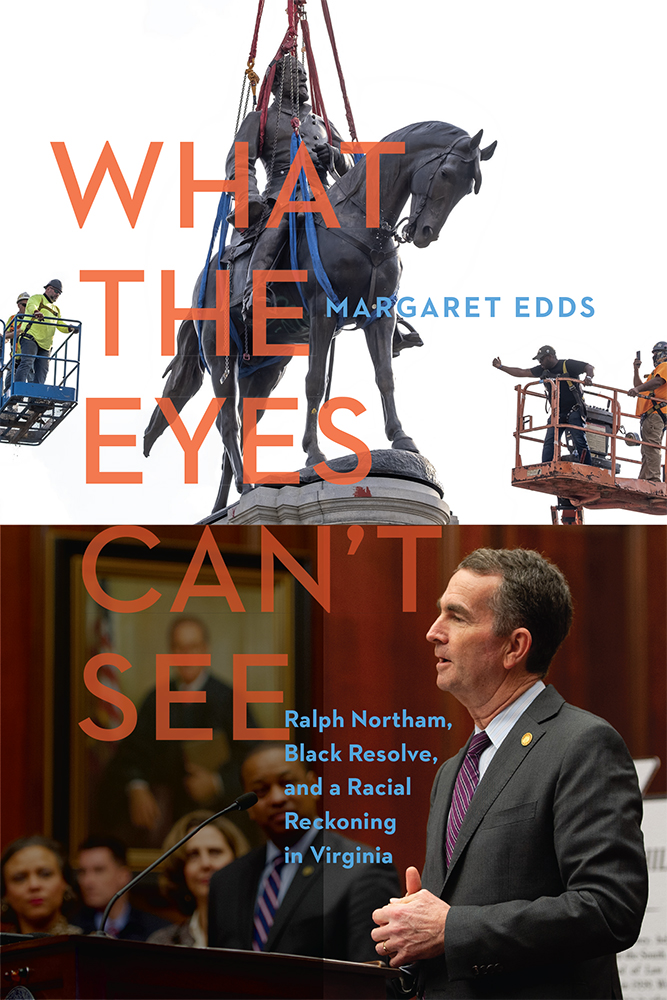
Margaret Edds. What the Eyes Can’t See: Ralph Northam, Black Resolve, and a Racial Reckoning. University of South Carolina Press, 2022. 243 Pages.
Reviewed by Bronwyn Hughes
Margaret Edds’ sixth book, What the Eyes Can’t See: Ralph Northam, Black Resolve, and a Racial Reckoning in Virginia, is a brilliant and engrossing compendium of Virginia’s racial politics spanning from 1619 when the first Africans arrived in shackles, through the removal of the Lee statue in Richmond in 2021. Throughout the narrative, she makes a strong case that Virginia’s former Governor, Ralph Northam, is a role model for White Americans today, arguing he redeemed himself in the wake of his blackface scandal.
In 2019, when a photo from Northam’s 1984 medical school yearbook page surfaced showing one person in blackface and another wearing KKK robes, almost everyone called for his immediate resignation. Though Northam didn’t believe he was in the yearbook photo, the scandal caused him to recognize his own ignorance about systemic racism in America. Rather than resign, Northam chose to educate himself through deep listening and learning about racism so he could work with Black leaders to bring about sweeping anti-racist legislative changes in Virginia.
The book’s title refers to something Northam liked to say to medical students: “The eyes can’t see what the brain doesn’t know.” Edds explains, “If you’ve never heard about a particular medical diagnosis, your brain won’t recognize it even if all the symptoms are staring you in the face.” The same goes for systemic racism.
Whether Northam redeemed himself through proactive anti-racist deeds is an interesting question to ponder as it raises the broader question of whether White America can redeem itself, and if so, what it would take. Edds’ challenging analysis of current and historic events in Virginia is a transformative resource for anyone struggling with racial reckoning.
William E. Johnson. A Silent Tide. 2022. 414 Pages.
Reviewed by Bronwyn Hughes
A Silent Tide is William E. Johnson’s first legal thriller published in 2013. This engaging novel is set in Mathews Virginia, a small community on the Chesapeake Bay where Johnson put down roots as a country lawyer. Well-paced and rich with cinematic scenes, the story reaches back to the prohibition era to span three generations of watermen characters.
The suspenseful plot hooks the reader from the start. Johnson weaves a Mexican cartel, Baltimore drug lords, and DEA officials, into a criminal supply chain relying on a Mathews waterman’s seafood business as a cover for smuggling drugs to major cities on the East Coast.
Johnson’s legal experience gives the narrative credibility, reminiscent of John Grisham novels. Other vivid details bring the story to life: “White rubber boots crunched against the sun bleached oyster shells…” Mouth-watering local food descriptions linger long after the scene has changed: “…six small soft shell crabs, a coveted delicacy of the Chesapeake Bay, lay like sheets of brined gold against the snow white of the old porcelain dinnerware.”
Trigger warning: The novel contains liberal use of the N word. Members of the all-White Mathews sheriff’s department form a lynch mob to avenge the death of a beloved White waterman. When the new-in-town lawyer makes the unpopular decision to serve as defense attorney for the Black defendant, the story has echoes of Harper Lee’s To Kill a Mockingbird.
In 2014, A Silent Tide won the National Indie Excellence Award. Johnson followed this success by publishing Tiffany’s Tale, a novella based on one of the most intriguing characters in A Silent Tide. His second full-length novel, A Silent Siege, was published in 2021. Set in the same locale, employing many of the same characters, Johnson’s second novel imagines ISIS terrorists seizing control of tranquil Mathews County.
Fans can take a “crime tour” of Johnson’s fiction, learn more about his books, or even hire him as an attorney by visiting his website: williamjohnsonbooks.com.
S.A. Cosby. My Darkest Prayer. Flatiron Books, 2022. 267 Pages.
Reviewed by Bronwyn Hughes
Shawn Cosby was born and raised in Mathews Virginia. One of few crime novelists to set his books in the rural South, his award-winning, bestselling southern noir thrillers have made him one of today’s top crime fiction writers.
His first book, My Darkest Prayer, was originally published in 2018 by a small press to little fanfare. After the runaway success of his second and third crime novels, Blacktop Wasteland and Razorblade Tears, his new publisher decided to reissue My Darkest Prayer in 2022 to make sure it received the attention it deserved.
My Darkest Prayer is set in a rural Black funeral home where the reader is hooked right away by the opening line: I handle the bodies. What follows is a well-plotted thriller that exposes hypocrisy within a rural Black church, rampant corruption within the sheriff’s department, a brutal crime lord, and a love interest who is a porn star.
One of the successful devices Cosby uses to lure the reader and propel the plot is to reveal the protagonist’s internal struggle to control his own violent nature. The closer the protagonist, an assistant funeral director, gets to discovering who murdered the local minister, the more people are killed, making him question why he got involved in the first place.
Cosby excels at writing violent scenes with cinematic flare, drawing on his history as a wrestler. His colorful descriptions (“Eyes like shards of obsidian”) and humor (“His thin lips split like a cheap pair of pantyhose”) flavor an otherwise gritty, bone-cracking ride toward the philosophically deep conclusion.
His next book, All the Sinners Bleed, is expected to be released in June of 2023.
Vivian Lawry. Dark Harbor: A Chesapeake Bay Mystery. iUniverse, Inc. 2009. 267 Pages.
Reviewed by Bronwyn Hughes
Set in a small college town on the eastern shore of the Chesapeake Bay, Vivian Lawry’s murder mystery, Dark Harbor, is a captivating page-turner from the shocking opening scene: “A body lay near the gas log fire, on its left side, curled into the fetal position. Stains, shiny and black, spattered the slate, smeared the floor, and clotted the hair.”
As the detective struggles to unravel the evidence, the real sleuth is Nora Perry, a willful red-headed feminist and psychology professor. The victim, also a professor, turns out to be a man several people had a motive to kill. Nora’s social connections at the college, as well as her knowledge of sailing, come in handy as she methodically rules out suspects one step ahead of the detective.
Lawry’s intimate knowledge of the potential for dysfunction within academia comes from twenty years of experience as a professor of psychology and her tenure as a Vice President for Academic Affairs at a small college. For expert knowledge of sailing details, she co-wrote the mystery with W. Lawrence Gulick, a merchant mariner during the Second World War. Their combined backgrounds add richness to the character-driven plot in the beautiful setting of the Chesapeake Bay.
Lawry knows no murder mystery would be complete without a throughline of sexual tension. Nora’s attraction to Van, another professor and amateur crime-solver, is complicated by her independence and his recent divorce. The detective, who is under pressure to solve the crime quickly to contain scandal, is another potential love interest for Nora. But that too is complicated by their past relationship.
The mystery’s surprising conclusion leaves the reader satisfied, yet craving more. Masterfully, Lawry ends on a note that opens the door for Dark Harbor‘s sequel,Tiger Heart!
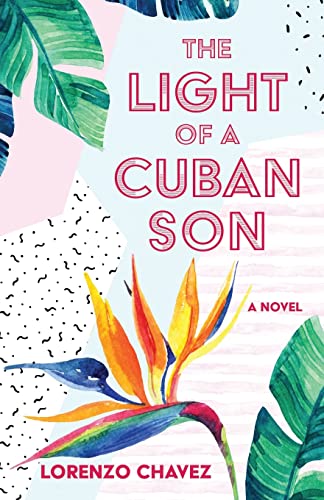
Lorenzo Chavez. The Light of a Cuban Son. Torchflame Books, 2022. 279 Pages.
Reviewed by Bronwyn Hughes
Lorenzo Chavez’s fictionalized memoir, The Light of a Cuban Son, is about a boy growing up gay in mid-twentieth century Cuba. The memoir is told chronologically through a series of poetic vignettes, each only a page or two long. Though Chavez hasn’t returned to Cuba in over fifty years, his love for his homeland glistens on every page.
An intimate coming of age story, the novel’s child sex abuse theme may disturb readers. As the narrator reflects on his childhood and adolescence, we learn that his mother’s mental illness and his father’s abandonment forced him to explore the world socially on his own. When he seeks guidance from adults outside of his family, the result is often sexual abuse.
Race and class are also recurring themes in the memoir. Though the narrator is light skinned, his family’s low income keeps him from belonging among Cuba’s elite class. This causes him to support the communists, though he reconsiders when the government nationalizes his beloved family farm.
The Cuban revolution is especially interesting to witness through a teenager’s eyes. For example, the narrator tastes peanut butter for the first time after the Bay of Pigs invasion due to an exchange of American food and medicine for prisoners. Despite living through political upheaval, like all teens the narrator is preoccupied with his social life. Only after he emigrates to Spain, and ultimately to the United States, does he learn to appreciate the significance of those times.
Chavez’s sensory memories of the landscape, food, and cultural traditions of his boyhood still seem crisp. Likewise, the traumatic events of those times still tingle with emotion. With deep compassion for his younger self, he shows how hope and determination enabled him to survive.
Learn more at: https://www.lorenzochavezauthor.com/novel

Anne Hobson Freeman. The Girl Who Was No Kin to the Marshalls and Other Stories. Dementi Books, 2021. 176 Pages.
Reviewed by Bronwyn Hughes
Anne Hobson Freeman made good use of her time during the pandemic by pulling together an impressive collection of ten stories, The Girl Who Was No Kin to the Marshalls. These classic stories were originally published in magazines and journals including Cosmopolitan, McCalls and the Virginia Quarterly over a span of four decades.
Born in 1934, Freeman has lived most of her life in Virginia, writing, teaching and raising a family. Her stories form an intriguing collage of mid-twentieth century vignettes of white southern girlhood. The title story for example, is about a girl who—against heavy odds—wins her grandmother’s respect during a summer visit to Lexington, Virginia. In another story, “Whatever Happened to Agnes Mason?” a girl at boarding school has a transformative experience after seeing the film Gone with the Wind.
The other stories feature characters navigating a range of life experiences, from a first job at the Virginia Museum of Fine Arts, to an elderly woman serving as a custodian for an historic church in Richmond. While most of the stories sparkle with humor, “A Question of Timing” is a surprising exception. It’s the story of a mother who scalds her young daughter with boiling water by accident. So well-rendered, the emotional detail sears the reader with the rawness of the mother’s trauma.
Overall, the stories convey Freeman’s playful sense of humor and her love for Virginia. Most take place in Richmond, but some venture as far as the nascent art world of Surry, or family vacations in the Tidewater region. One of the stories, “Hugh,” steps out of Virginia to tell of a woman who attends her college reunion, intent on reconnecting with the man she almost married.
With insight and sensitivity, these engaging stories succeed at recalling earlier times without feeling nostalgic. The delightful illustrations that accompany the stories are the work of the author’s daughter-in-law, Louise Freeman.
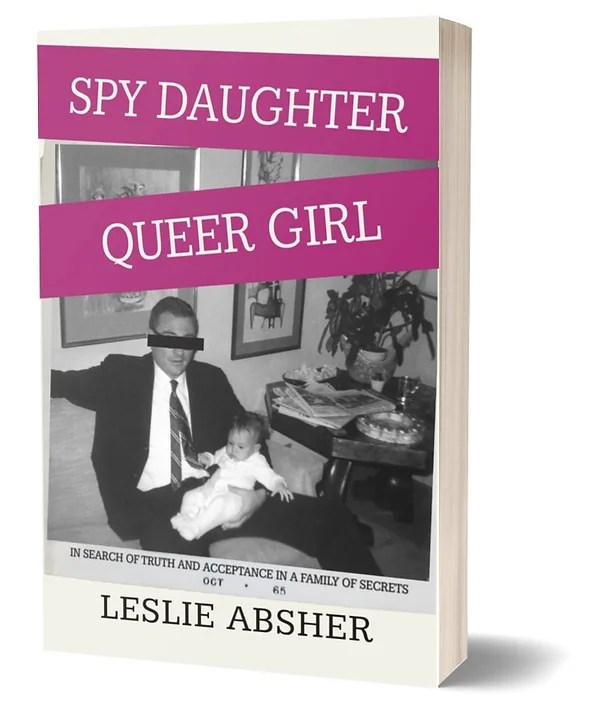
Leslie Absher. Spy Daughter, Queer Girl. Latah Books, 2022. 264 Pages.
Reviewed by Bronwyn Hughes
Leslie Absher’s intriguing memoir, Spy Daughter, Queer Girl, explores her relationship with her father and their struggle to accept each other. While he found Leslie’s lesbianism troubling, Leslie found his evasiveness about his secret life in the CIA deeply unsettling.
The inspiration for Leslie’s memoir came from a workshop she attended in Greece with the famous feminist and working-class storyteller, Dorothy Allison. At the end of the workshop, Leslie asked Dorothy’s opinion on whether her essay about her CIA father was ready to send out. “With that wry smile of hers she said, ‘I think it’s a book.” Leslie says she “wasn’t prepared for that answer at all.” After the shock wore off, Leslie dove into the project. Nearly twenty years later, the book Dorothy Allison envisioned is here.
Leslie says her life-long practice of journaling “gave me permission to tell my story to myself before I was ready to share it publicly.” Her journals also provided key source material to write a memoir about the two taboo topics in her family. As the project developed, she realized the story she wanted to tell was not simply an expose of her father’s role in the CIA, but her own story of how the two secrets captured in the title Spy Daughter, Queer Girl intertwined. “In my family, secrets were the air that we breathed.”
The two issues that would become central to Leslie’s memoir began to surface in the early ‘80’s while she was a boarding student at Madeira. On top of losing her mother to breast cancer during her junior year, Leslie wrestled alone with questions about her sexuality. In those days, nobody felt safe coming out, and the school offered no resources for LGBTQ students. At the same time, she suspected some of her classmates had a parent in the CIA, but nobody felt safe talking about that either. As a result, she felt locked inside two closets. Her friends, as well as some caring teachers, provided the primary support she needed to get through that difficult period. “One of Madeira’s wonderful and compassionate English teachers helped me write my first personal essay about losing my mother to breast cancer.”
According to Leslie, it was common for spy-kids to not know their parent worked for the CIA. In her family, the subject came up when she was thirteen during a Sunday drive. Her mother prompted her father to tell the girls the truth by saying, “You work for the CIA, don’t you.” Her father gripped the wheel and couldn’t speak. Leslie remembers that scene as a key moment in her childhood, “like an explosion.” Afterwards, her family’s culture of silence resumed.
Years later, Leslie broke the family silence again by coming out to her father. He reacted by saying he couldn’t accept it, but “there’s no reason for us to lose contact.” Leslie explained, “For years my father compartmentalized our secrets differently. He felt his secret was a noble one to protect the United States, while mine served to hide abnormal behavior.”
Leslie’s memoir tunnels toward the truth about her father’s work. She was grateful to have a younger sister as an ally in the family who not only accepted her sexuality without reservation, but witnessed and validated Leslie’s suspicions as they compared notes on their father’s shadowy behavior.
Sections of the memoir read like a detective novel with fascinating details about the Greek junta, a right-wing military dictatorship that ruled Greece from 1967-1974. Leslie felt driven to know if her father helped to install the anti-communist dictatorship responsible for mass imprisonment and torture. “I told him I was writing a nonfiction book about my childhood in Greece, and I think he had the idea that it was largely about his work, but he never asked me not to write it.” Even so, the idea of outing her father terrified her. “As a spy-kid, it was a deep, emotional job to allow myself to speak out about my spy-parent.”
Leslie admits she and her father were a lot alike, both stubbornly loyal to their convictions despite polarized social and political views. By the end of his life, the two had come a long way toward accepting each other and strengthening their relationship.
Writing her memoir has been a healing process for Leslie. “Ultimately, the exposure and vulnerability of writing this book has been worth it. I feel liberated, and it’s empowering to finally be seen.”
This moving and insightful debut was released by Latah Books on October 11th. Copies may be ordered on Leslie’s website: leslieabsher.com.
 Bronwyn Hughes